Is a Prop Firm the Same as a Broker? No.
Is a Prop Firm the Same as a Broker? No — Here's the Real Difference
Is a prop firm the same as a broker? No. They sit on opposite sides of your trade. A broker gives you access to the market with your own money. A prop firm evaluates your trading and, if you pass, lets you trade a funded account and keep a share of the profit.
People mix them up because both have a dashboard, both show you charts, and both let you place trades. That's where the similarity ends.

What a broker actually does
A broker is the middleman between you and the market. You deposit your own money, the broker executes your trades, and you keep 100% of whatever you make — or lose 100% of whatever you lose. The broker earns through spreads, commissions, or fees, not through your trading performance.
Your capital is your own the whole time. Nobody evaluates you before you're allowed to trade. You can open a broker account and place a trade five minutes later, with real money you deposited yourself.
What a prop firm actually does
A prop firm — short for proprietary trading firm — doesn't take your deposit. Instead, you pay a one-time evaluation fee to prove you can trade within a defined set of rules: profit targets, a maximum drawdown, a minimum number of trading days.
Pass the evaluation, and you get a funded account sized to what you proved you could handle — capital you never deposited, trading simulated in a controlled environment, with real payouts if you're profitable. The firm isn't earning off spreads on your trades. It's earning a share of your profit if you're consistently good, and the one-time fee either way.
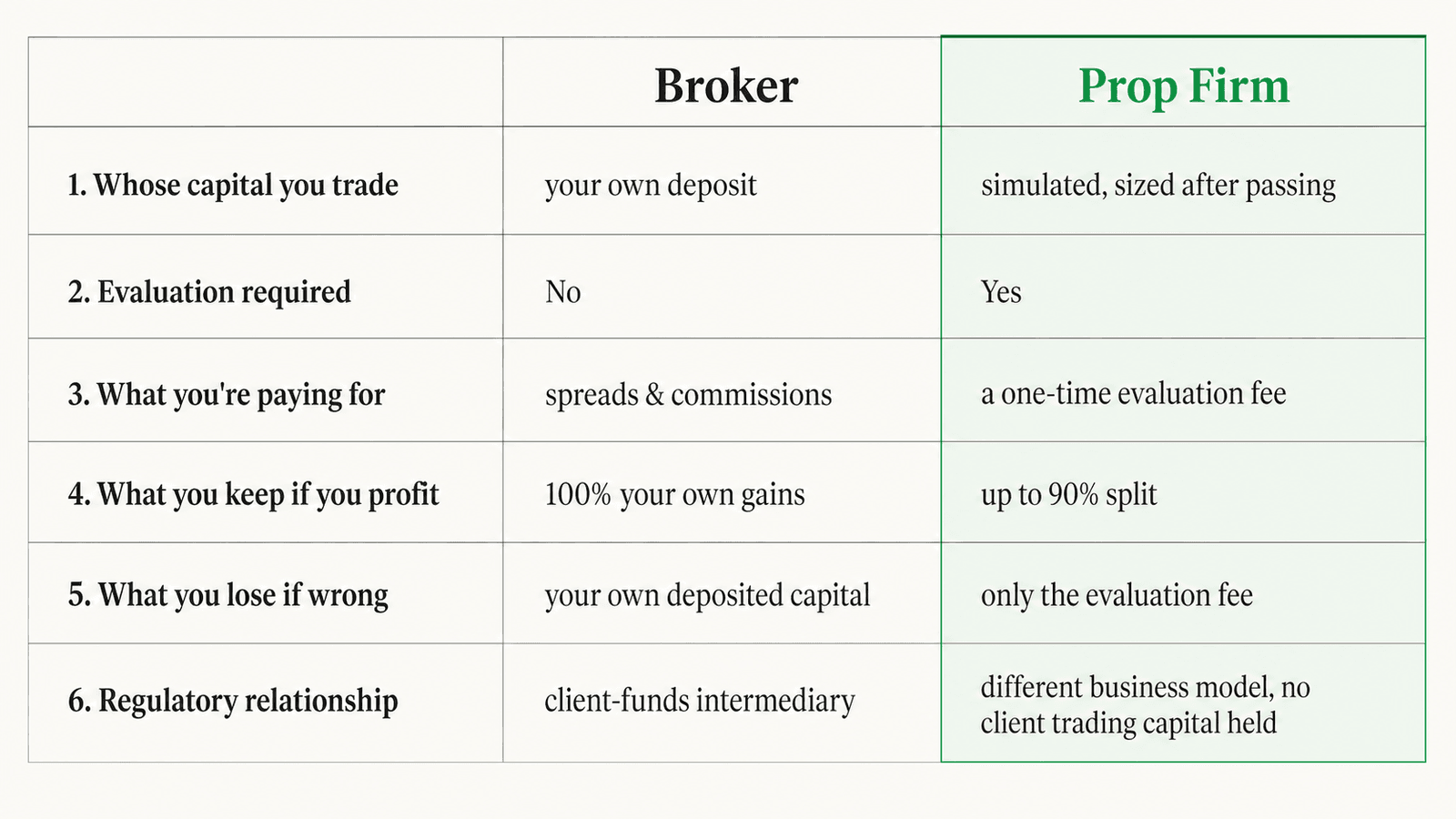
Broker vs prop firm, side by side
| Broker | Prop Firm | |
|---|---|---|
| Whose capital do you trade | Your own, deposited by you | Simulated capital, sized after you pass an evaluation |
| Do you need to pass anything first | No | Yes — a rules-based evaluation |
| What you're paying for | Spreads, commissions, platform access | A one-time evaluation fee |
| What you keep if you profit | 100% of your own gains | A profit split — up to 90% depending on the product |
| What you lose if you're wrong | Your own deposited capital | Only the evaluation fee — you never deposit trading capital |
| Regulatory relationship | Regulated as a financial intermediary handling client funds | Not holding client trading capital — a different business model entirely |
Why the confusion happens
Both give you a login, a platform, live prices, and the ability to click buy or sell. From the trading screen alone, they can look identical. The difference is entirely in what's behind the screen: whose money is actually on the line, and what you had to do to get access to it.
A broker account is available to almost anyone who can fund it. A funded prop firm account is only available to someone who's already demonstrated — under real rules, with real consequences for breaking them — that they can trade with discipline. That's the entire point of the evaluation: it replaces "trust me" with proof.
Which one do you actually need
If you have your own capital and want direct control over every dollar of it, a broker is the right tool — you're trading your own money, your own risk, your own upside.
If you don't want to risk your own capital to scale up your trading, or you've proven a strategy works but don't have the capital to size it properly, a prop firm evaluation is the more honest path — you're never told to "trade our capital" in some vague sense; you pay a fee, prove discipline under a fixed rule set, and get a funded account sized to what you demonstrated.
Most serious traders eventually use both — a broker for their own capital, a prop firm evaluation to scale beyond it without depositing more of their own money.
Quick questions
Is a prop firm regulated the same way as a broker? No. A broker is regulated as a financial intermediary handling client deposits and trade execution. A prop firm evaluation doesn't hold client trading capital in the same way, so it isn't regulated identically — always check a firm's actual entity and jurisdiction before paying an evaluation fee.
Do I need a broker account to use a prop firm? No. A prop firm evaluation runs on its own platform — you don't need a separate broker account to take the challenge or trade a funded account.
Which one is cheaper to start with? A broker account can be opened with as little as your first deposit. A prop firm evaluation has a fixed one-time fee — on TBM Funded, starting at $36 for the smallest account size.
Can I lose more than the evaluation fee with a prop firm? No. You never deposit trading capital with a prop firm — the most you can lose is the one-time fee you paid for the evaluation.
More questions like these are answered in our full FAQ.
Risk disclaimer: Trading forex and CFDs carries real risk and can result in loss of your capital. Prop firm challenges involve fees and don't guarantee funding or income. This isn't financial, legal, or tax advice — see our full Risk Disclosure.