Cheapest Prop Firm Challenge: What You Actually Get
Cheapest Prop Firm Challenge: What You Actually Get for the Price
The cheapest prop firm challenge you can buy right now costs under $50. That's not a marketing number — it's just what a small evaluation account actually costs when you're not paying for a $100,000 account size you don't need yet.
But "cheapest" is a trap if you stop reading after the price tag. The fee is only half the question. What you're evaluated against — the drawdown, the targets, the split you keep afterward — is the half that actually decides whether the cheap challenge was worth buying.

What's the actual cheapest prop firm challenge available
On TBM Funded, the lowest entry point is the Soldier tier — $5,000 account size, 2-Phase evaluation, $36. That's the real floor: the smallest account size on the cheapest product structure.
| Rank | Size | 2-Phase Fee | Rapid Fee |
|---|---|---|---|
| Soldier | $5,000 | $36 | $45 |
| Capo | $10,000 | $66 | $79 |
| Mad Men | $25,000 | $156 | $189 |
| Boss | $50,000 | $289 | $349 |
| Don | $100,000 | $529 | $629 |
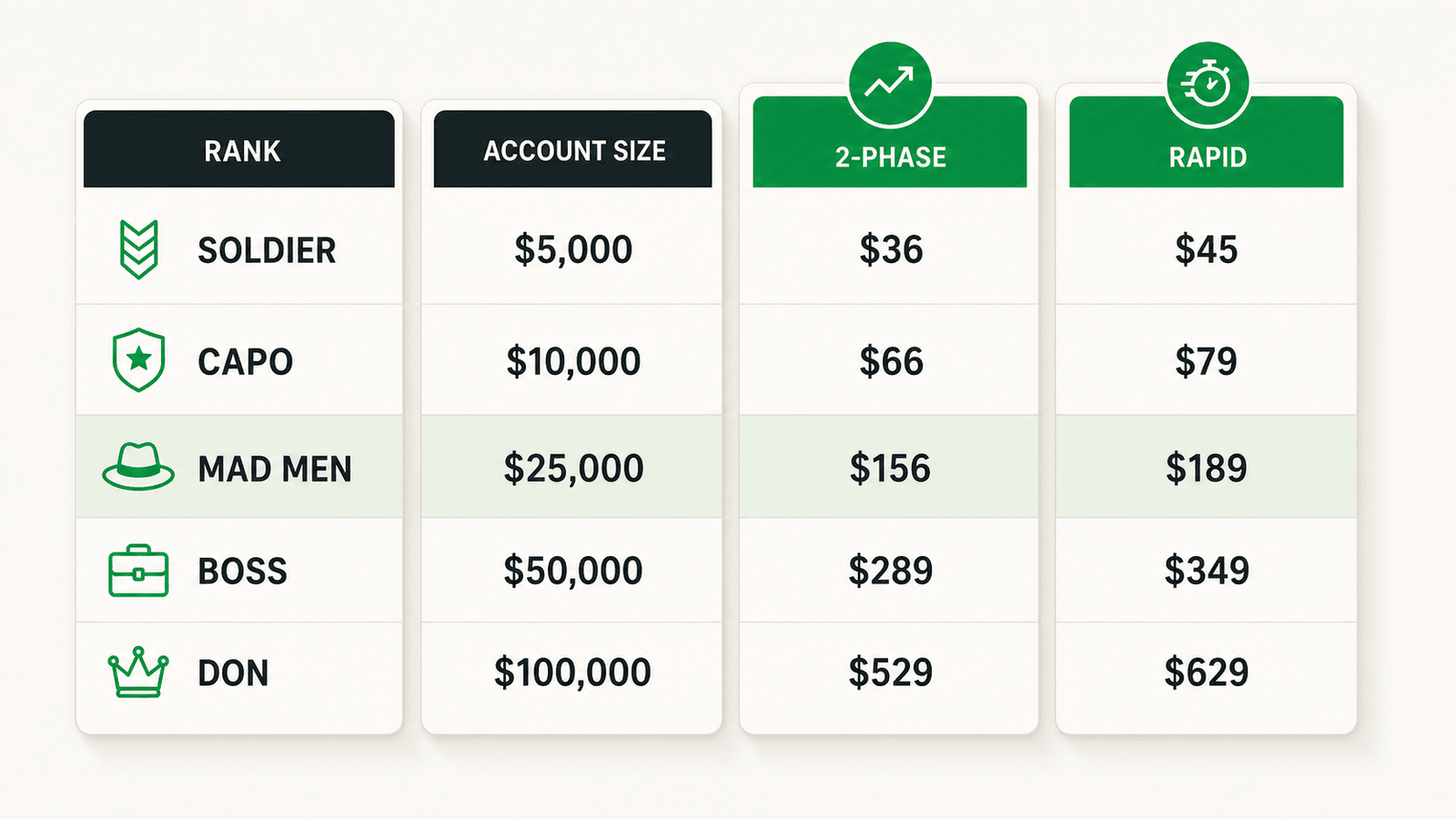
Every size runs the identical rule set — same profit targets, same drawdown percentage, same minimum trading days. A $5,000 evaluation isn't a watered-down version of a $100,000 one. It's the same test, smaller stakes.
Why "cheapest" and "best value" aren't the same question
A $36 fee sounds cheap right up until you fail it twice and pay $72 chasing an account size you never needed. The actual cheapest way to get funded is the fee that matches your real trading size, bought once, passed once.
This is a straightforward cost-per-attempt problem, not a discount-hunting one. If you can trade a $25,000-sized strategy competently but keep buying $5,000 challenges because they're cheaper upfront, you're not saving money — you're buying more attempts at a smaller number. Position sizing matters as much in picking your evaluation size as it does in placing an actual trade.
Hidden costs that make a "cheap" challenge expensive
The sticker price isn't the whole bill. Watch for these before you buy anywhere:
- Reset fees that aren't actually discounted. Some firms charge close to full price to restart a failed evaluation — the "cheap" entry fee was just the first of several full-price purchases.
- Subscription-style challenges. A monthly fee that keeps charging until you pass (or give up) can end up costing more than a single higher upfront fee.
- Split reductions that only apply after the cheap tier. A firm can advertise a low entry fee while quietly capping the profit split at the smallest account size.
- Payout minimums that erase small wins. A cheap account paired with a high minimum withdrawal means your first few winning cycles just accumulate instead of paying out.
None of these show up in the headline price. They show up in the fine print, which is exactly where you should be looking before you buy — the same due diligence you'd apply to any financial product, not just a prop firm challenge.
How to actually pick a low-cost challenge without shooting yourself in the foot
Start from your real trading size, not the lowest number on the pricing page. If you can competently manage a $10,000-sized position without your emotions changing, buying a $5,000 challenge just to save $30 doesn't make sense — you're more likely to pass the size you actually trade.
From there, check the full rule set, not just the fee: max drawdown, daily drawdown, minimum trading days, and whether the drawdown is static or trailing during the evaluation. Two challenges at the same price can have very different odds of passing depending on how tight the rules are.
Full targets, drawdown, and fee breakdowns for every size are on Pricing, and the complete rulebook — same at every tier — is on How It Works. If you're unsure which size actually fits your trading, our account size guide walks through it directly.
Quick questions
What's the cheapest prop firm challenge on TBM Funded? The Soldier tier — a $5,000 account on the 2-Phase product — at $36. It runs the exact same rules as every larger size.
Is a cheaper challenge easier to pass? No. Price scales with account size, not difficulty. The percentage targets, drawdown limits, and minimum trading days are identical across every tier on both products.
Should I always buy the cheapest option? Only if it matches how much you'd actually trade with once funded. Buying cheap and failing repeatedly costs more than buying the right size once.
Do cheaper challenges have a lower profit split? Not on TBM. The split is set by product — 80% on 2-Phase, up to 90% on Rapid — at every account size from Soldier to Don.
More questions like these are covered in our full FAQ.
Risk disclaimer: Trading forex and CFDs carries real risk and can result in loss of your capital. Prop firm challenges involve fees and don't guarantee funding or income. This isn't financial, legal, or tax advice — see our full Risk Disclosure.